Less downtime, more molding cycles: the repair that changes everything.
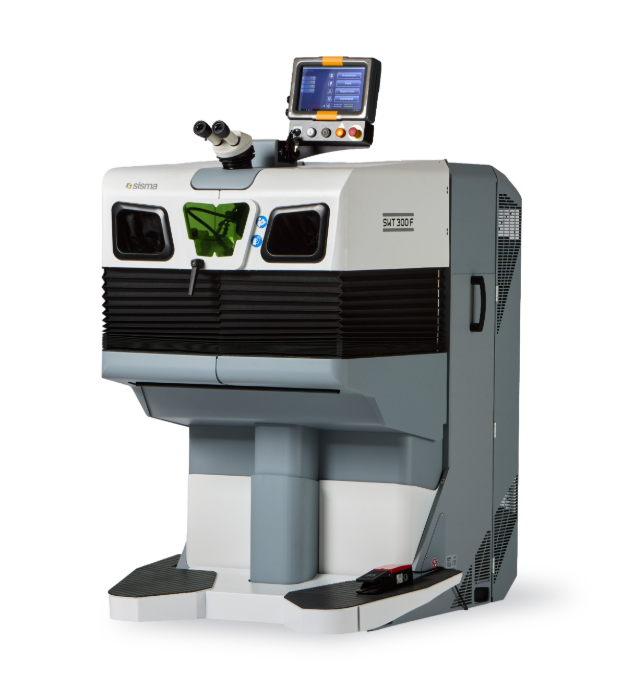
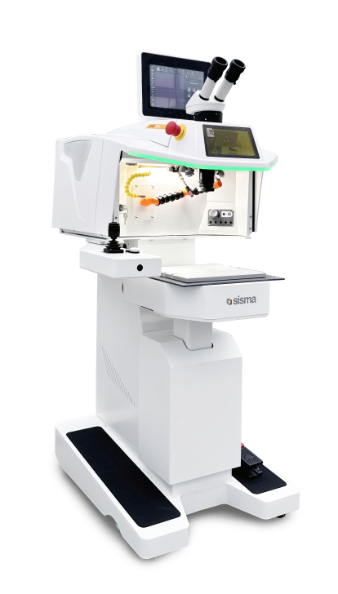
Fast and effective mold repairs guarantee production continuity and on-time delivery to customers. Sisma laser welding machines — lamp or fiber — put injection molds, die-casting and hot molding molds back into production with timing, levels of precision and quality that go far beyond those of traditional repair methods.
CHALLENGES OF
TRADITIONAL REPAIR
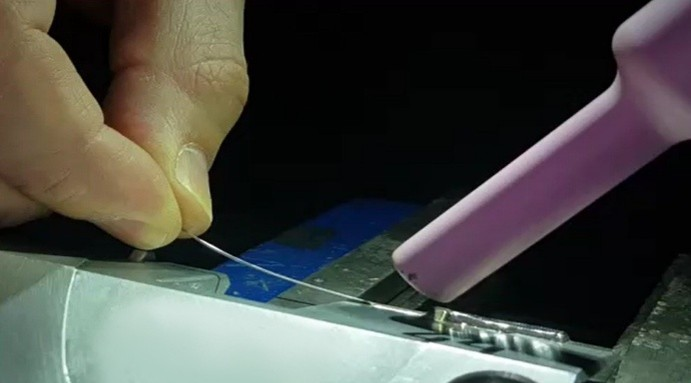
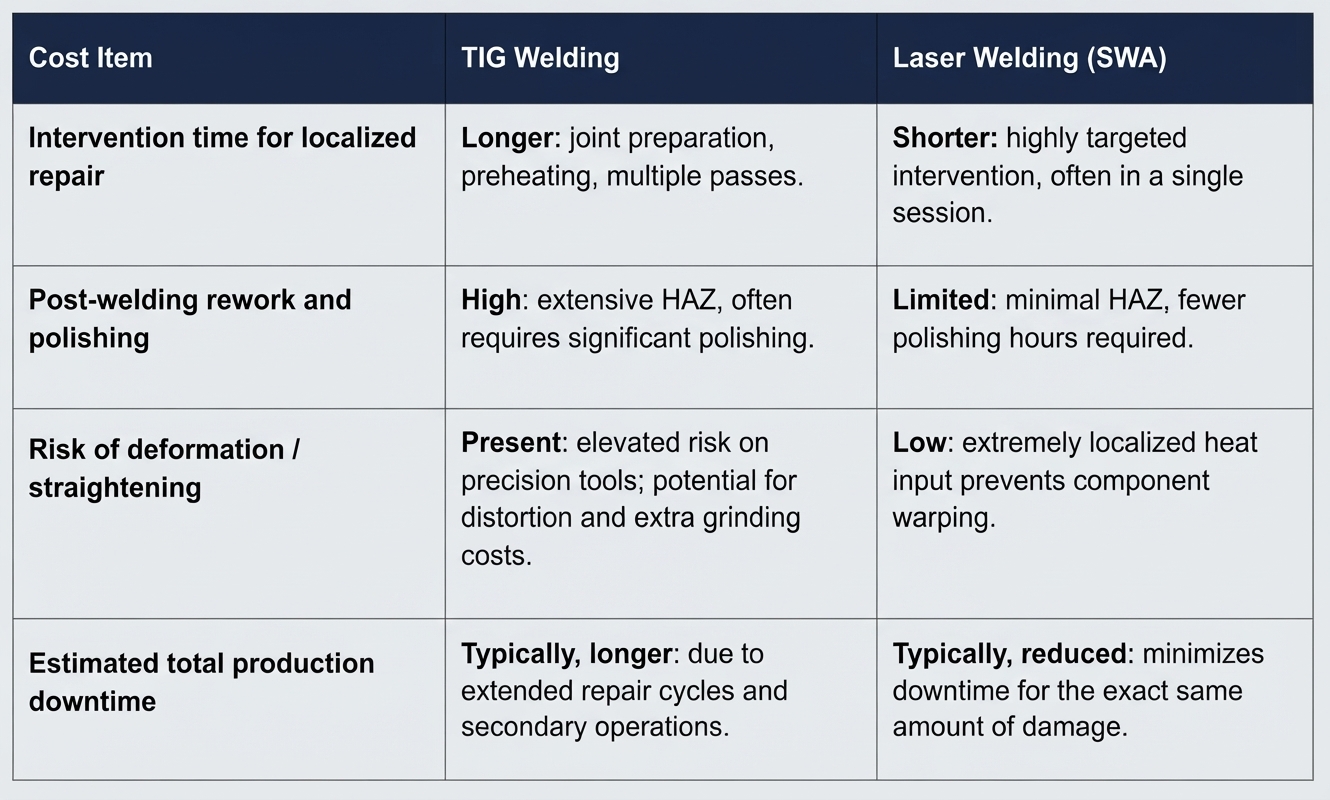
Every chip, thermal stress crack, or worn area on a production mold forces the department to make a choice: either stopping production for a lengthy, potentially inaccurate repair, or living with a defect that compromises the molded part. Traditional welding techniques — TIG in the first place — often require preheating, multiple passes and an extended heat-affected zone, with the real risk of deforming a precision mold or compromising its surface hardness in the repaired area. There is a better alternative: the laser solution.
HOW LASER WELDING WORKS FOR MOLD REPAIR
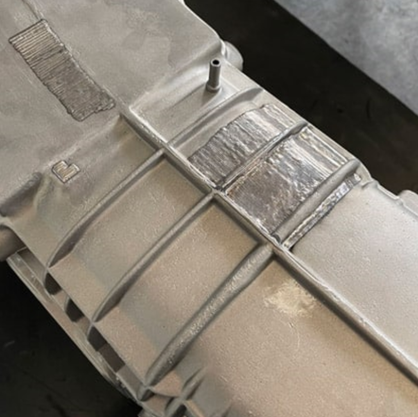
Laser welding for mold repair uses a pulsed beam to locally melt the base metal with a filler wire. This process delivers an extremely low, concentrated heat input to an area of just a few tenths of a millimeter directly where the repair is needed.
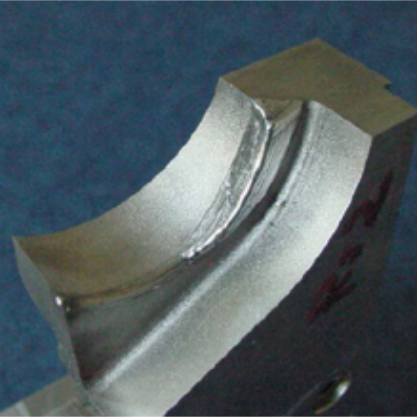
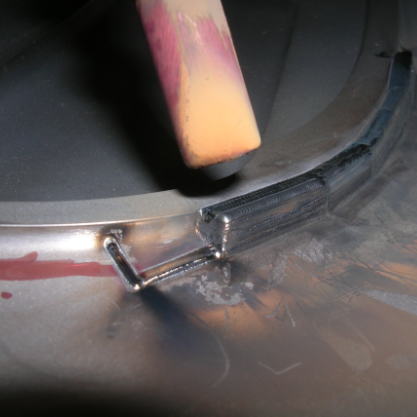
The result is a dense weld seam, well bonded to the base material, with a minimal heat-affected zone (HAZ)- The result is zero mold deformation, unaltered material hardness, and perfectly preserved dimensional tolerances.
Turn scrapped molds into operational assets
If your team is currently discarding or manually reworking worn molds using traditional techniques, it is worth exploring what precision laser technology can achieve.
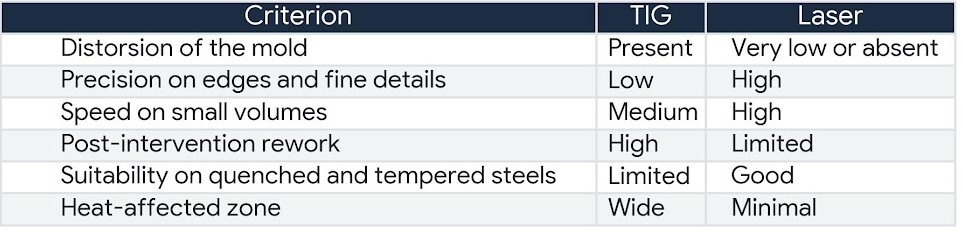
While laser technology does not replace every repair method, it is now the preferred option for precision molds. The table below provides a qualitative comparison between laser welding and the most widely used traditional technologies, based on key operational criteria.
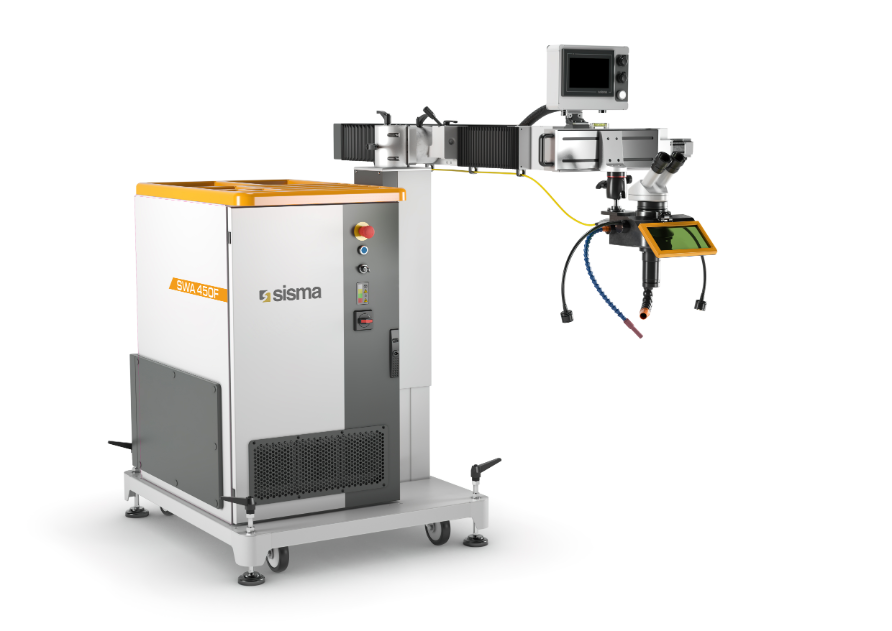
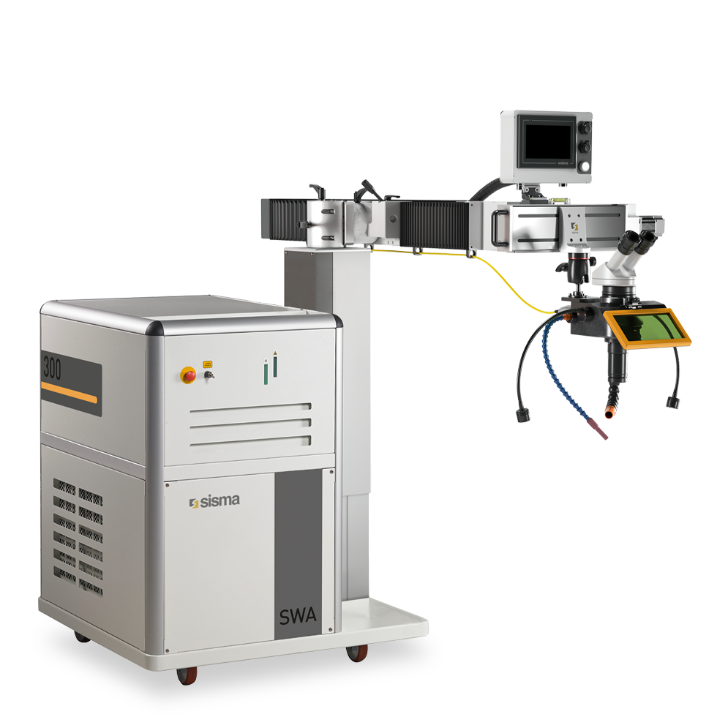
laser welding systems for mold regeneration of any size and format:
Laser welding machines for repairing molds of all types and sizes
• Plastic injection molds: restoration of edges, threads, sealing zones and visible surfaces.
• Die-casting and hot-forging dies: repair of thermal fatigue cracks (heat checking) and erosion-prone areas.
• Blanking and drawing dies: restoration of cutting edges and mating surfaces.
• Engineering changes: adding material to modify dimensions or adapt the mold to new part revisions.
• Rebuilding of date inserts
Restoration of edges
Repair of thermal fatigue cracks (heat checking) and erosion-prone areas.
Engineering changes
Restoration of edges
Repair of thermal fatigue cracks (heat checking) and erosion-prone areas.
Engineering changes:
THE ECONOMIC ISSUE:
TIG vs laser on medium-large molds
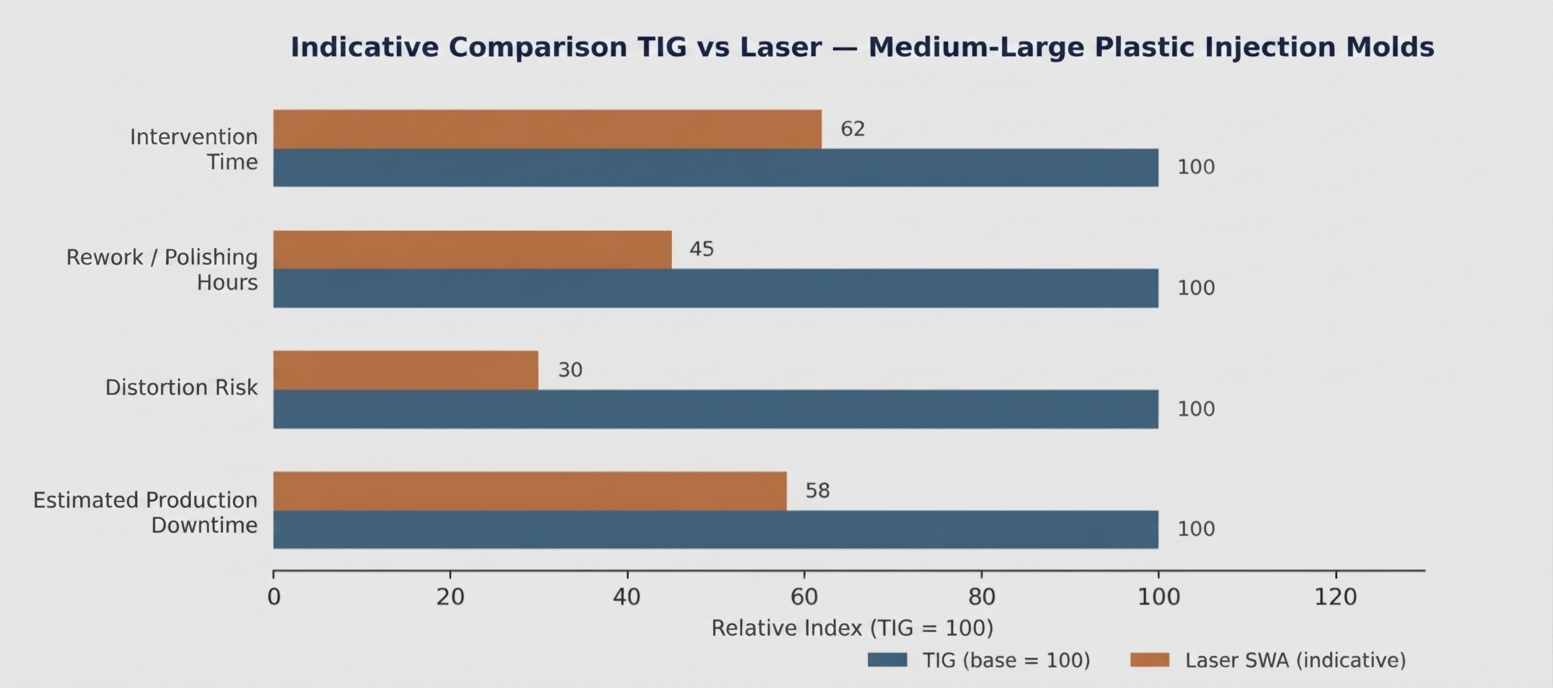
THE ECONOMIC ASPECT: TIG vs laser on medium-large molds For medium-to-large injection molds (approximately 500 to 1,000 kg), featuring high-visibility surfaces and tight tolerances, the comparison between the two technologies comes down to three key factors: skilled labor, machine downtime, and post-weld rework. These typical market values for the mold industry serve as a baseline for economic evaluation. Actual data should be confirmed based on the customer’s specific sector and operational parameters.
Indicative average values, to be confirmed for each specific sector Indicative comparison between the two technologies on the main criteria; relative index TIG = 100.
When does investing in a laser welder make sense?
The decision between outsourcing repairs or having an in-house SISMA laser welding system depends primarily on the frequency of the work. If you repair molds multiple times a month, you will quickly see a return on investment by minimizing downtime and supplier dependency. If your repair needs are only occasional, starting with an external service is a practical choice before purchasing your own laser system.
Driving efficiency: How one of our customers upgraded their toolroom with SISMA laser systems
Molds represent a major financial investment. Repairing them internally significantly extends their overall service life.
SPEED:
In-house mold repair drastically reduces production downtime. In many cases, molds can be repaired directly on the press without disassembly.
SAFETY:
On-site repair eliminates transportation risks, which is especially critical when handling large and heavy molds.
CONFIDENTIALITY:
Protecting proprietary mold designs is essential. Internal repair prevents sensitive technical information from leaking to competitors.
With Sisma you have much more than a welding machine.
A reliable partner for laser technology
With Sisma you have much more than a welding machine.
A reliable partner for laser technology
Choosing SISMA means empowering your business with 25+ years of laser welding innovation and a global footprint of thousands of installations. We guide you at every step:
Feasibility Analysis: Comprehensive material and volume studies for optimal efficiency. Custom Consulting: Engineering the perfect technical and financial fit for your operations. Total Support: A dedicated service team covering everything from testing to long-term after-sales care. Proudly Made in Italy: All systems are built entirely in Piovene Rocchette (VI).
FAQ
Laser vs. TIG: Does laser welding completely phase out TIG in mold repair?
No: TIG remains useful for large-volume cladding where deposition speed matters more than surface finish. Laser is the choice when precision, a minimal HAZ (Heat Affected Zone), and zero distortion are critical.
Is specialized personnel required to operate a SISMA laser system?
Specific training is required, but operation is more accessible compared to TIG welding: many mold and die shops train internal operators in a short period of time.
Does the laser work on all mold steels?
The laser works well on most quenched and tempered steels; however, the choice of filler wire must be evaluated on a case-by-case basis.
Is a lamp-pumped or fiber laser more cost-effective?
It depends on the size of the mold shop—and therefore the required productivity—the available budget, and the prevailing type of materials. For example, lamp-pumped lasers are preferred for reflective materials like copper or aluminum.
Il numero seriale o il numero Matricola si trovano in una targhetta applicata sulla macchina. Inizia con OR per le macchine a catena e per L o LS per le macchine laser.