In dental implantology, traceability is not just a minor detail: it is what identifies a component and links it to the patient who receives it. B&B Dental, a Bologna-based company specializing in this sector, has entrusted SISMA with the development of a laser marking process for equipment and implants, serving both functional and traceability purposes. The markings must be imperceptible to the touch and remain perfectly legible over time, withstanding—in the case of equipment—repeated cycles of decontamination and autoclave sterilization.
Meeting both requirements involves removing very little material, while carefully adjusting the laser power, engraving speed, and spindle rotation. It is a delicate balance: a marking that is too shallow may fade over time, while one that is too deep can promote bacterial adhesion.
The tests were conducted on a SISMA BSP machine equipped with a rotary-tilting spindle. The SLC3 software, interfaced with the CVS coaxial vision system, automatically identifies the area to be marked and precisely positions text, codes, and Data Matrix symbols even on complex geometries, such as the hexagonal head of a stump or the hollow interior of an implant.
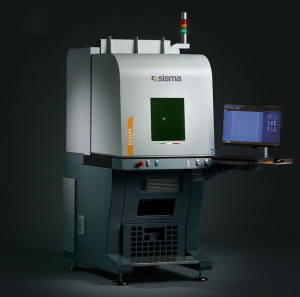
BSP Pico, the SISMA machine used in tests with a 50-watt ultrashort-pulse laser source.
On this platform, two laser sources were compared: a 20 W MOPA and a 50 W Pico ultrashort-pulse laser. Here is a summary of the results obtained for the various components:
(2 bands + code)
| Component | 20 W MOPA Laser | 50 W Pico Laser |
| Key shank with ring nut (logo + inscription + 2 bands) | 2′ 55″, clearly legible dark gray markings | 1′ 24″, more intense markings and sharper lettering |
| Graduated key body (scale) | ~40 sec, good visibility | Smaller, denser digits, better results |
| Lancet bur | ~55 sec, excellent legibility | Results confirmed |
| Data Matrix on abutment (1.16 × 1.16 mm) | ~10 sec, readable under a microscope | Significantly superior quality and resolution |
| Data Matrix on the system (0.4 × 0.4 mm) | Not feasible | ~10 sec, guaranteed readability under a microscope |
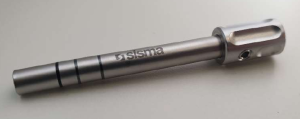
The final result on the key shank with the ring nut: the Sisma mark and bands of continuous blackening, clearly legible and almost imperceptible to the touch.
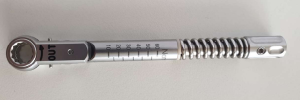
The final result on the graduated key body: a graduated scale that is clearly legible and almost imperceptible to the touch.
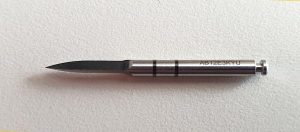
The final result on the lanceolate milling cutter features bands and an alphanumeric code that are clearly legible and almost imperceptible to the touch.
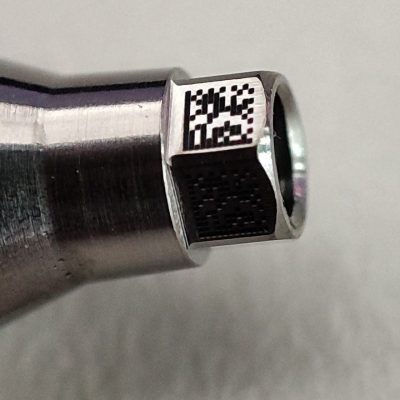
A Data Matrix code must be marked on both the abutment and the implant to certify their mutual correspondence: a key requirement for the device’s traceability. On the abutment, a 1.16 × 1.16 mm code in 12×12 format is marked on the hexagon in approximately 10 seconds and is perfectly readable with a Cognex 8600 reader.
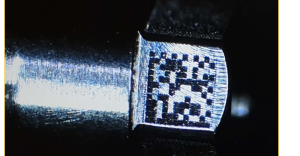
The Data Matrix code marked on the stump, as seen under a microscope.
The only available surface on the device is the interior, which is difficult to reach, and the space for the code is limited to just 0.4 × 0.4 mm in a 10×10 format—a size that is beyond the capabilities of the MOPA laser. Only the 50 W Pico laser, thanks to its ultrashort pulses, was able to mark the code in about 10 seconds, with guaranteed readability under a microscope.
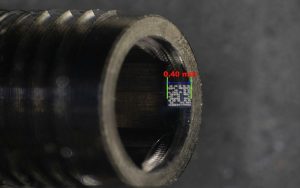
The 0.4 × 0.4 mm Data Matrix code marked inside the device, which can only be read using a Pico laser.
SISMA’s software systems fully integrate with the SQL database to generate and manage UDI (Unique Device Identification) labeling, as required by FDA and EU MDR regulations, ensuring security, flexibility, repeatability, and traceability throughout the entire production process.
|
What is the UDI?
Unique Device Identification (UDI) allows medical devices to be identified and tracked throughout their entire lifecycle. It combines a device identifier (UDI-DI) with manufacturing information (UDI-PI) in a compact, machine-readable format, such as a 2D Data Matrix code. |
The B&B Dental–SISMA case study demonstrates how ultrashort-pulse laser technology, combined with coaxial digital vision and automated data management, is currently the most effective solution for marking small and complex dental devices.