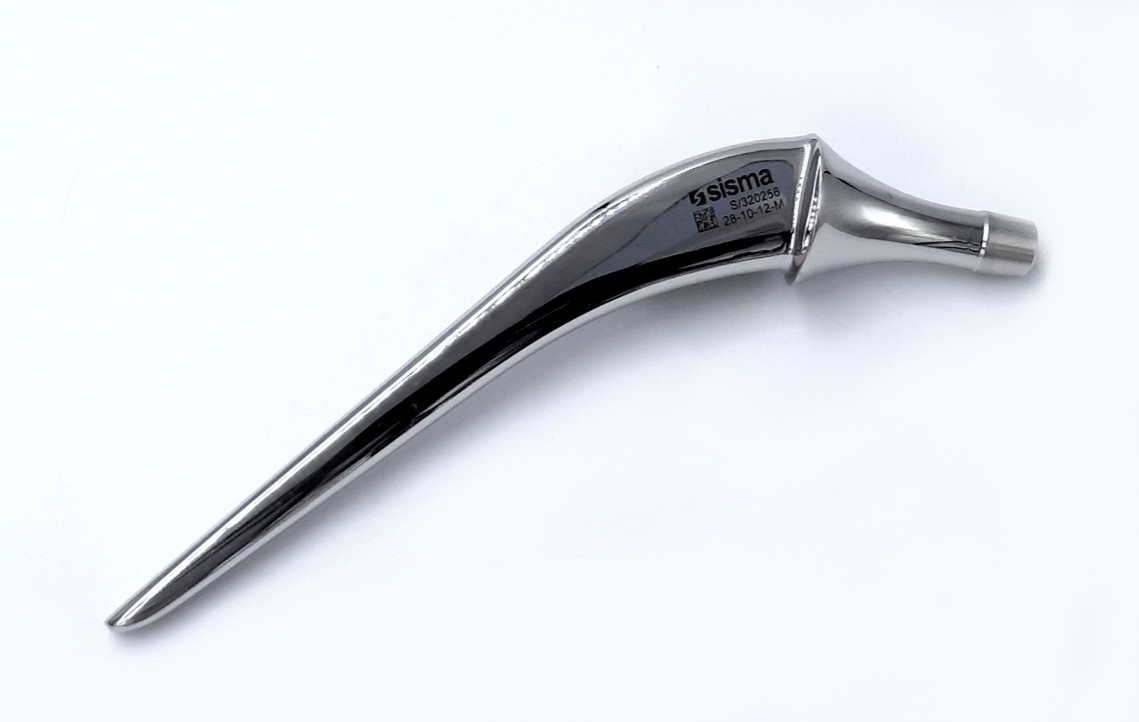
Traceability: The Starting Point
Every prosthesis and every medical device must be uniquely identifiable throughout its entire lifecycle. It was this need that led Sofab Orthopédie, a major holding company based in the Rhône-Alpes region, to reach out to Sisma: to laser-mark prostheses and other metal medical devices while maintaining the high quality and meeting the stringent requirements of the medical field, all while streamlining production.
Marking is the foundation of UDI (Unique Device Identification) traceability [Learn More], as required by FDA regulations and the EU MDR.
The customer’s goal was clear: a stable marking process on a reliable machine, with a high degree of automation and flexibility. The system operates 5 days a week, in two 8-hour shifts.
The Challenge: Different Parts, Same Standards
Versatility. The project involves five very different product families: femoral heads, tibial stems, double-mobility cups of various sizes, other prostheses, and surgical guides. A single machine must handle parts with different geometries, dimensions, and implant positions.
Repeatability and precision. The customer requires medical-grade blackening marking: chemical resistance and excellent legibility on cobalt-chromium, titanium, and stainless steel. All of this must be achieved with very short cycle times to increase productivity.
Integration. The system must communicate with the company database via SQL queries, automatically load marking projects, and automatically detect the position of components.
The Sisma Solution: BSP Pico with WH10 Vertical Magazine
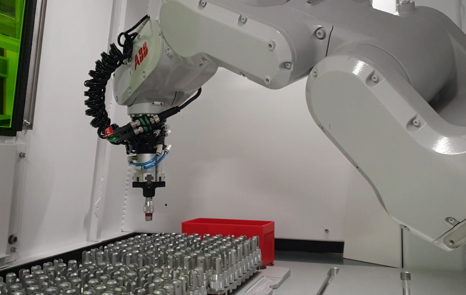
To meet these needs, we proposed the BSP Pico laser marker combined with the WH10 automatic loading magazine featuring 10 trays. The magazine increases productivity and the level of automation, and enables unattended operation. The software is integrated with the customer’s SQL database: it retrieves data, generates the UDI marking, and automatically loads the marking projects.
Materials and Finishes: Testing Readability
In consultation with the customer, we tested four materials, developing two sets of parameters for each, in search of the best quality in the shortest possible cycle time.
The benchmark. The sample is a partially polished metal disc. We marked two 2D codes on both the polished and the matte sides for each set of parameters. The result is four different levels of readability, to verify how the finish and parameters affect reading.
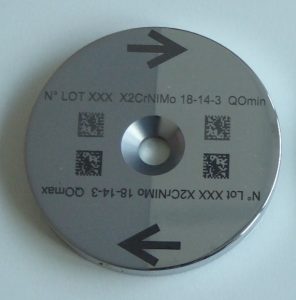
Accuracy, repeatability, and part recognition: CVS and Pattern Matching
Dimensional accuracy. On the X2CrNiMo steel samples, we measured the letter “Q” and the tail of the arrow. The measured values are 1.9916 mm and 1.5713 mm, compared to expected heights of 2 mm and 1.5 mm.
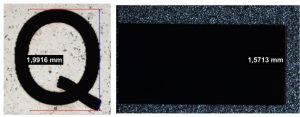
Measured repeatability.
To simulate mass production, we marked a series of elements (0.5 × 18 mm rectangles) on the plane in the X and Y directions, with a pitch of 10 mm. The positions were defined using the Coaxial Vision System (CVS)
[Learn more]. The marking was then repeated using the MULTI software option, setting the offset on the axes.
The maximum deviation from the nominal position was 15.5 µm over a 90 mm stroke.
Part Recognition. The combination of CVS and Pattern Matching [Learn More] ensures the precision and reliability required for mass production by automatically recognizing the part and detecting its position.
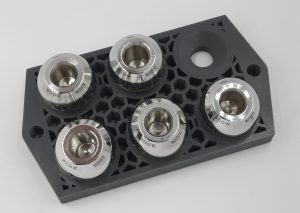
Durability: The marking remains intact; the material does not deteriorate
A medical marking must last as long as the device itself, without compromising the material. That is why we subjected it to two tests under particularly harsh conditions.
We have carried out:
Conclusions
The collaboration between Sisma and Sofab was essential to achieving a repeatable process that complies with medical regulations.
The Design Qualification (DQ) defined the acceptance criteria and the necessary documentation, and the Performance Qualification (PQ) demonstrated that BSP Pico fully meets and exceeds all requirements.
In summary, the project confirmed the key points requested by the client:





10.03.2026
SISMA has recently been featured in two of Italy’s leading national newspapers, Corriere della Sera and La Repubblica, in special sections dedicated to the excellence of Italian-made products. The articles, published in early March 2026, provide an in-depth look at the company’s evolution and the role of precision engineering in the development of the jewellery, fashion, medical and industrial sectors.
Featured in these publications further confirms SISMA’s position as a leading player in the field of laser technologies and advanced manufacturing, capable of combining innovation, quality and strategic vision.


17.12.2025
On 16 December 2025, SISMA welcomed students from the ITS Eyewear Product Manager course to its Piovene Rocchette site for a day dedicated to training and direct engagement with the manufacturing sector
The event was designed as an opportunity for practical exchange, allowing participants to explore materials, technologies and processes applied to the eyewear sector, whilst offering them a close-up view of industrial dynamics. Among the topics covered, particular attention was paid to a case study on titanium eyewear, analysing its properties and design potential.
The visit continued inside the company’s laboratories, where students were able to observe metal 3D printing processes and the activities of the metallographic laboratory at close quarters, gaining an understanding of the fundamental role of materials analysis in ensuring product quality, durability and reliability.
The initiative forms part of the ongoing collaboration with Certottica Group, with the aim of creating opportunities for interaction between education and industry and contributing to the development of skills within the region.


Traceability: The Starting Point
Every prosthesis and every medical device must be uniquely identifiable throughout its entire lifecycle. It was this need that led Sofab Orthopédie, a major holding company based in the Rhône-Alpes region, to reach out to Sisma: to laser-mark prostheses and other metal medical devices while maintaining the high quality and meeting the stringent requirements of the medical field, all while streamlining production.
Marking is the foundation of UDI (Unique Device Identification) traceability [Learn More], as required by FDA regulations and the EU MDR.
The customer’s goal was clear: a stable marking process on a reliable machine, with a high degree of automation and flexibility. The system operates 5 days a week, in two 8-hour shifts.
The Challenge: Different Parts, Same Standards
Versatility. The project involves five very different product families: femoral heads, tibial stems, double-mobility cups of various sizes, other prostheses, and surgical guides. A single machine must handle parts with different geometries, dimensions, and implant positions.
Repeatability and precision. The customer requires medical-grade blackening marking: chemical resistance and excellent legibility on cobalt-chromium, titanium, and stainless steel. All of this must be achieved with very short cycle times to increase productivity.
Integration. The system must communicate with the company database via SQL queries, automatically load marking projects, and automatically detect the position of components.
The Sisma Solution: BSP Pico with WH10 Vertical Magazine
To meet these needs, we proposed the BSP Pico laser marker combined with the WH10 automatic loading magazine featuring 10 trays. The magazine increases productivity and the level of automation, and enables unattended operation. The software is integrated with the customer’s SQL database: it retrieves data, generates the UDI marking, and automatically loads the marking projects.
Materials and Finishes: Testing Readability
In consultation with the customer, we tested four materials, developing two sets of parameters for each, in search of the best quality in the shortest possible cycle time.
The benchmark. The sample is a partially polished metal disc. We marked two 2D codes on both the polished and the matte sides for each set of parameters. The result is four different levels of readability, to verify how the finish and parameters affect reading.
Accuracy, repeatability, and part recognition: CVS and Pattern Matching
Dimensional accuracy. On the X2CrNiMo steel samples, we measured the letter “Q” and the tail of the arrow. The measured values are 1.9916 mm and 1.5713 mm, compared to expected heights of 2 mm and 1.5 mm.
Measured repeatability.
To simulate mass production, we marked a series of elements (0.5 × 18 mm rectangles) on the plane in the X and Y directions, with a pitch of 10 mm. The positions were defined using the Coaxial Vision System (CVS)
[Learn more]. The marking was then repeated using the MULTI software option, setting the offset on the axes.
The maximum deviation from the nominal position was 15.5 µm over a 90 mm stroke.
Part Recognition. The combination of CVS and Pattern Matching [Learn More] ensures the precision and reliability required for mass production by automatically recognizing the part and detecting its position.
Durability: The marking remains intact; the material does not deteriorate
A medical marking must last as long as the device itself, without compromising the material. That is why we subjected it to two tests under particularly harsh conditions.
We have carried out:
Conclusions
The collaboration between Sisma and Sofab was essential to achieving a repeatable process that complies with medical regulations.
The Design Qualification (DQ) defined the acceptance criteria and the necessary documentation, and the Performance Qualification (PQ) demonstrated that BSP Pico fully meets and exceeds all requirements.
In summary, the project confirmed the key points requested by the client:
In dental implantology, traceability is not just a minor detail: it is what identifies a component and links it to the patient who receives it. B&B Dental, a Bologna-based company specializing in this sector, has entrusted SISMA with the development of a laser marking process for equipment and implants, serving both functional and traceability purposes. The markings must be imperceptible to the touch and remain perfectly legible over time, withstanding—in the case of equipment—repeated cycles of decontamination and autoclave sterilization.
Meeting both requirements involves removing very little material, while carefully adjusting the laser power, engraving speed, and spindle rotation. It is a delicate balance: a marking that is too shallow may fade over time, while one that is too deep can promote bacterial adhesion.
The tests were conducted on a SISMA BSP machine equipped with a rotary-tilting spindle. The SLC3 software, interfaced with the CVS coaxial vision system, automatically identifies the area to be marked and precisely positions text, codes, and Data Matrix symbols even on complex geometries, such as the hexagonal head of a stump or the hollow interior of an implant.
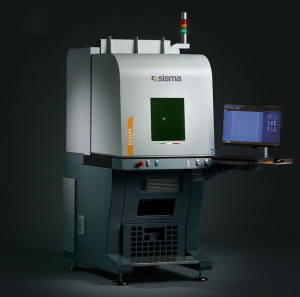
BSP Pico, the SISMA machine used in tests with a 50-watt ultrashort-pulse laser source.
On this platform, two laser sources were compared: a 20 W MOPA and a 50 W Pico ultrashort-pulse laser. Here is a summary of the results obtained for the various components:
(2 bands + code)
| Component | 20 W MOPA Laser | 50 W Pico Laser |
| Key shank with ring nut (logo + inscription + 2 bands) | 2′ 55″, clearly legible dark gray markings | 1′ 24″, more intense markings and sharper lettering |
| Graduated key body (scale) | ~40 sec, good visibility | Smaller, denser digits, better results |
| Lancet bur | ~55 sec, excellent legibility | Results confirmed |
| Data Matrix on abutment (1.16 × 1.16 mm) | ~10 sec, readable under a microscope | Significantly superior quality and resolution |
| Data Matrix on the system (0.4 × 0.4 mm) | Not feasible | ~10 sec, guaranteed readability under a microscope |
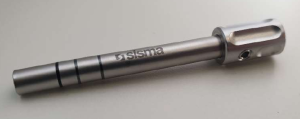
The final result on the key shank with the ring nut: the Sisma mark and bands of continuous blackening, clearly legible and almost imperceptible to the touch.
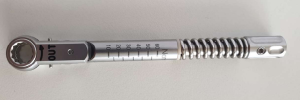
The final result on the graduated key body: a graduated scale that is clearly legible and almost imperceptible to the touch.
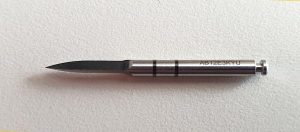
The final result on the lanceolate milling cutter features bands and an alphanumeric code that are clearly legible and almost imperceptible to the touch.
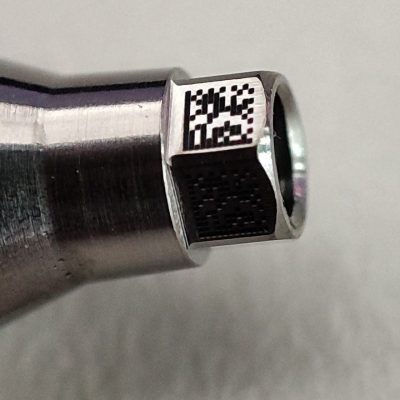
A Data Matrix code must be marked on both the abutment and the implant to certify their mutual correspondence: a key requirement for the device’s traceability. On the abutment, a 1.16 × 1.16 mm code in 12×12 format is marked on the hexagon in approximately 10 seconds and is perfectly readable with a Cognex 8600 reader.
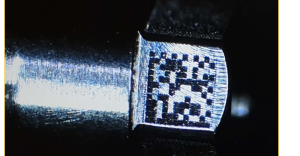
The Data Matrix code marked on the stump, as seen under a microscope.
The only available surface on the device is the interior, which is difficult to reach, and the space for the code is limited to just 0.4 × 0.4 mm in a 10×10 format—a size that is beyond the capabilities of the MOPA laser. Only the 50 W Pico laser, thanks to its ultrashort pulses, was able to mark the code in about 10 seconds, with guaranteed readability under a microscope.
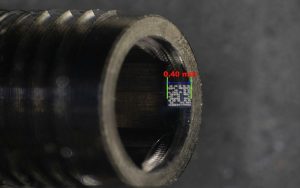
The 0.4 × 0.4 mm Data Matrix code marked inside the device, which can only be read using a Pico laser.
SISMA’s software systems fully integrate with the SQL database to generate and manage UDI (Unique Device Identification) labeling, as required by FDA and EU MDR regulations, ensuring security, flexibility, repeatability, and traceability throughout the entire production process.
| What is the UDI?
Unique Device Identification (UDI) allows medical devices to be identified and tracked throughout their entire lifecycle. It combines a device identifier (UDI-DI) with manufacturing information (UDI-PI) in a compact, machine-readable format, such as a 2D Data Matrix code. |
The B&B Dental–SISMA case study demonstrates how ultrashort-pulse laser technology, combined with coaxial digital vision and automated data management, is currently the most effective solution for marking small and complex dental devices.


In dental implantology, traceability is not just a minor detail: it is what identifies a component and links it to the patient who receives it. B&B Dental, a Bologna-based company specializing in this sector, has entrusted SISMA with the development of a laser marking process for equipment and implants, serving both functional and traceability purposes. The markings must be imperceptible to the touch and remain perfectly legible over time, withstanding—in the case of equipment—repeated cycles of decontamination and autoclave sterilization.
Meeting both requirements involves removing very little material, while carefully adjusting the laser power, engraving speed, and spindle rotation. It is a delicate balance: a marking that is too shallow may fade over time, while one that is too deep can promote bacterial adhesion.
The tests were conducted on a SISMA BSP machine equipped with a rotary-tilting spindle. The SLC3 software, interfaced with the CVS coaxial vision system, automatically identifies the area to be marked and precisely positions text, codes, and Data Matrix symbols even on complex geometries, such as the hexagonal head of a stump or the hollow interior of an implant.
BSP Pico, the SISMA machine used in tests with a 50-watt ultrashort-pulse laser source.
On this platform, two laser sources were compared: a 20 W MOPA and a 50 W Pico ultrashort-pulse laser. Here is a summary of the results obtained for the various components:
(2 bands + code)
| Component | 20 W MOPA Laser | 50 W Pico Laser |
| Key shank with ring nut (logo + inscription + 2 bands) | 2′ 55″, clearly legible dark gray markings | 1′ 24″, more intense markings and sharper lettering |
| Graduated key body (scale) | ~40 sec, good visibility | Smaller, denser digits, better results |
| Lancet bur | ~55 sec, excellent legibility | Results confirmed |
| Data Matrix on abutment (1.16 × 1.16 mm) | ~10 sec, readable under a microscope | Significantly superior quality and resolution |
| Data Matrix on the system (0.4 × 0.4 mm) | Not feasible | ~10 sec, guaranteed readability under a microscope |
The final result on the key shank with the ring nut: the Sisma mark and bands of continuous blackening, clearly legible and almost imperceptible to the touch.
The final result on the graduated key body: a graduated scale that is clearly legible and almost imperceptible to the touch.
The final result on the lanceolate milling cutter features bands and an alphanumeric code that are clearly legible and almost imperceptible to the touch.
A Data Matrix code must be marked on both the abutment and the implant to certify their mutual correspondence: a key requirement for the device’s traceability. On the abutment, a 1.16 × 1.16 mm code in 12×12 format is marked on the hexagon in approximately 10 seconds and is perfectly readable with a Cognex 8600 reader.
The Data Matrix code marked on the stump, as seen under a microscope.
The only available surface on the device is the interior, which is difficult to reach, and the space for the code is limited to just 0.4 × 0.4 mm in a 10×10 format—a size that is beyond the capabilities of the MOPA laser. Only the 50 W Pico laser, thanks to its ultrashort pulses, was able to mark the code in about 10 seconds, with guaranteed readability under a microscope.
The 0.4 × 0.4 mm Data Matrix code marked inside the device, which can only be read using a Pico laser.
SISMA’s software systems fully integrate with the SQL database to generate and manage UDI (Unique Device Identification) labeling, as required by FDA and EU MDR regulations, ensuring security, flexibility, repeatability, and traceability throughout the entire production process.
| What is the UDI?
Unique Device Identification (UDI) allows medical devices to be identified and tracked throughout their entire lifecycle. It combines a device identifier (UDI-DI) with manufacturing information (UDI-PI) in a compact, machine-readable format, such as a 2D Data Matrix code. |
The B&B Dental–SISMA case study demonstrates how ultrashort-pulse laser technology, combined with coaxial digital vision and automated data management, is currently the most effective solution for marking small and complex dental devices.


